Compete to crack secrets lost to history—for fun, clout, and (no) profit
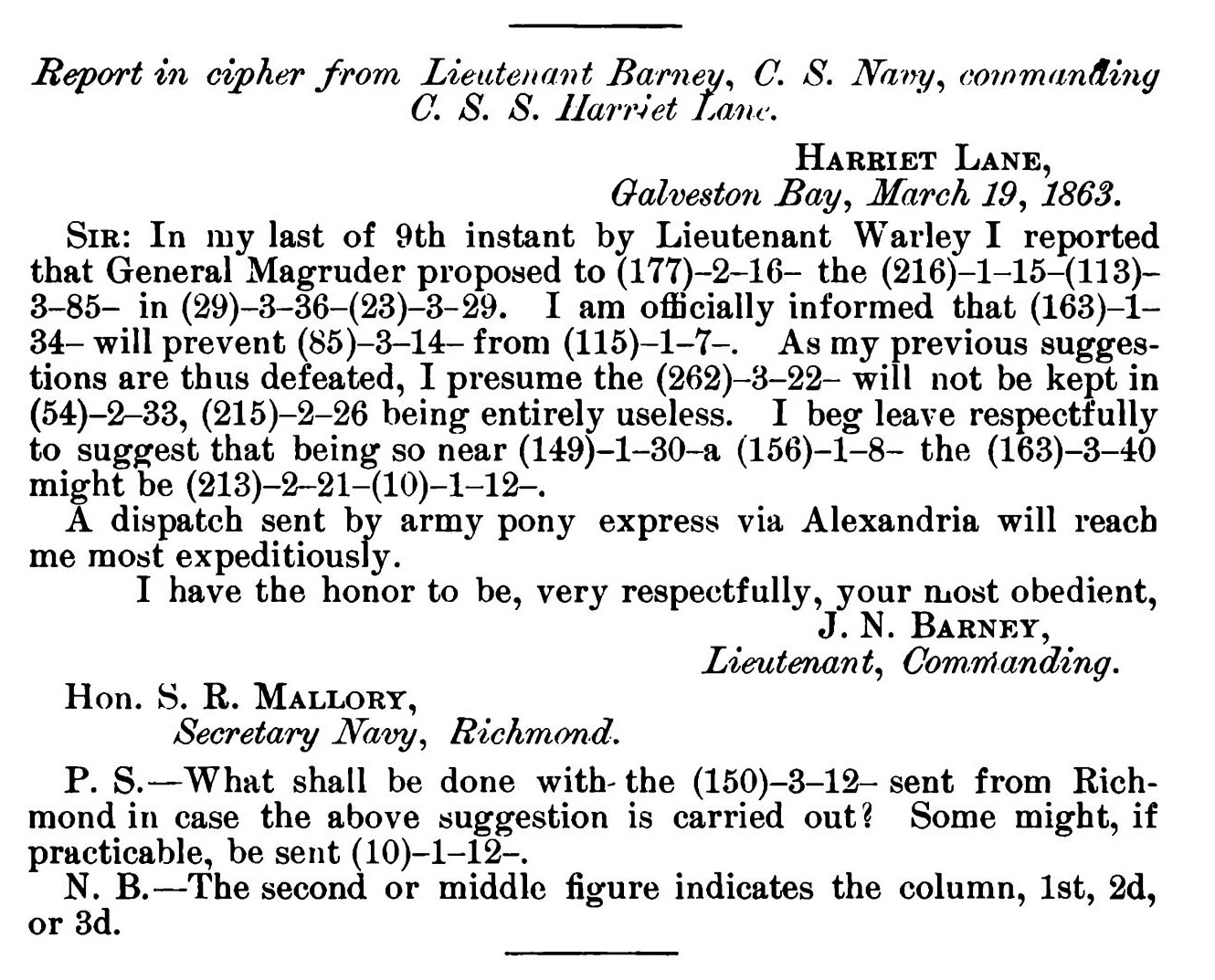
Start with only the printed page[1], and do not assume anything about the method. Eighteen words in the report were replaced by number groups, and each group is three numbers, like 177-2-16. Sort them and a pattern shows up straight away. The first number of a group runs anywhere from 10 to 262. The middle number is only ever 1, 2 or 3. The third runs from 7 to 85.
A number that never leaves the range 1 to 3 is not carrying much information, so it is probably not part of the message at all. Barney settles it in a note at the foot of his own letter: the middle figure is the column. That suggests an address in a shared book: page, column, position. And an address is only useful if both men are holding the same book, so somewhere there is a printed book with at least 262 pages and three columns on each of them.
One group repeats exactly. (10)-1-12 appears once in the body of the letter and once in the postscript. That repeat is a gift, because it is a test you can run on any answer you come up with later. If the address idea is right, both looks land on the same spot in the same book and have to give back the same word, and that word has to make sense in two different sentences. Any candidate book that fails this is wrong, however good the rest of it looks.
The archive then hands over the rest for free. Barney had written to Mallory on 23 February saying he was sending a copy of Webster’s Dictionary for the purpose, and Raphael Semmes, the Confederate raider captain, described the same trick in 1861[3]. So we know the family of system before any codebreaking starts. This is a dictionary code: instead of scrambling the letters of a word, you look the word up in a book you and your correspondent both own and send its address. The encipherment replaces words with addresses. Identifying the right book is the central task.
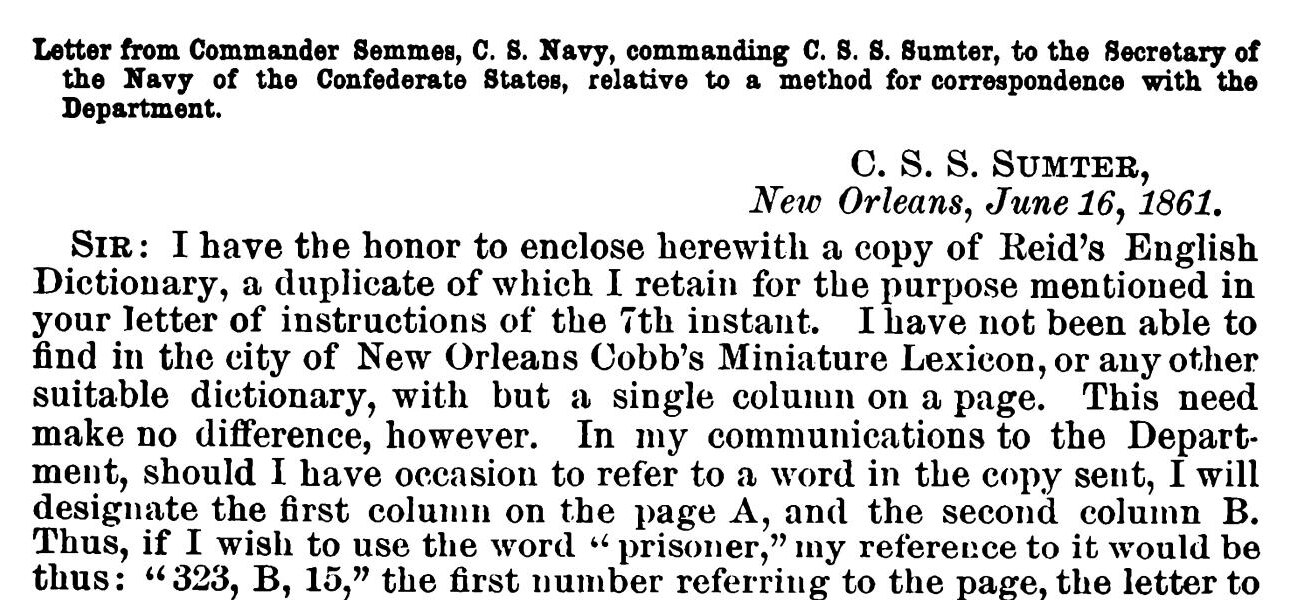
Knowing it is a Webster is not the same as having one. Different editions and typesettings place entries differently. A word sixteenth down a column in one edition can sit elsewhere in another. The name Webster does not by itself identify the pages used by these correspondents.
So the job is not codebreaking in the usual sense, it is identification. Find the exact printing and the message falls out on its own. That sounds easier than it is, and here is the trap: a wrong printing does not fail loudly. Look up eighteen addresses in the wrong edition and you still get eighteen perfectly ordinary English words. They just do not mean anything together. Wrong answers look like answers.
Three things have to be true of the right book, and all three come from the numbers themselves. It has to be a Webster laid out with three columns to a page, because the middle number never goes above 3. It has to run to at least 262 pages of entries, because that is the highest page number asked for. And it has to be a book where all eighteen addresses land on words that add up to one sensible naval report.
The third test is the one that does the work. A candidate edition must produce words that fit the report. In particular, the one word returned by the repeated (10)-1-12 must fit both places where Barney uses it.
The book that passes is an 1850 revised Primary-School Pronouncing Dictionary of the English Language, a cheap schoolbook rather than the famous unabridged Webster. Because “an 1850 Webster” is still ambiguous, the claim is pinned to one scanned copy anyone can open (HathiTrust hvd.32044086661170)[4], so a reader checking this is looking at the same pixels rather than at a different survivor of the same year.
Having the book still leaves one question, and it is the question that sinks most attempts. The third number counts something down the column, but counts what? Printed lines? Every word on the page? Dictionary entries?
Counting physical lines fails immediately, because definitions run several lines and the totals overshoot. What works is counting displayed headword starts, the bold words that begin an entry, from the top of the column. Do not count a definition continued from the previous column, do not wrap into the next column, and do not repair an ordinal that runs past the end of the column.
So 177-2-16 is printed page 177, middle column, sixteenth displayed headword: PLACE. The letter opens “General Magruder proposed to (177)-2-16- the …” and becomes “proposed to PLACE the …”
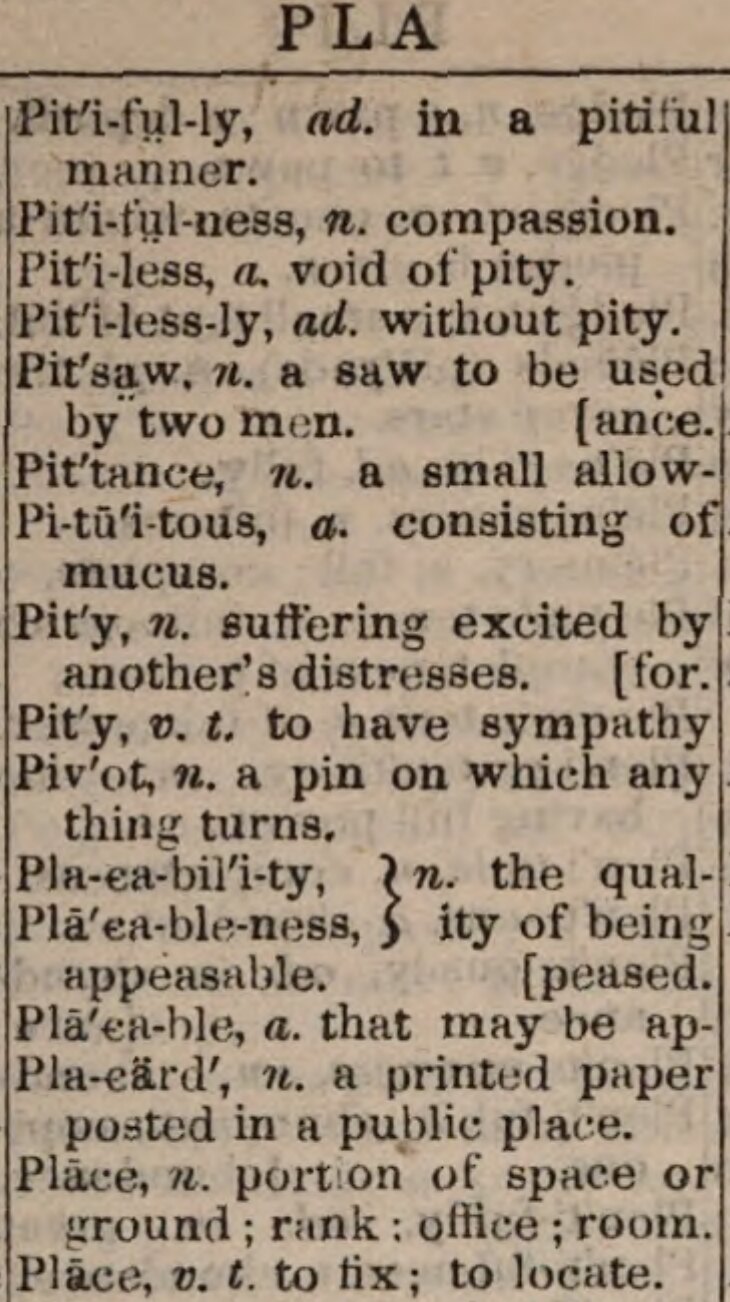
That rule was not invented to make this letter work, which would be circular. It also settles an unrelated Confederate Navy message: Semmes’s 323-B-15[5] only gives a sensible word, Prisoner, when you count headwords the same way. Counting printed lines gives the wrong entry there too.
| # | Coordinate | Word | Note |
|---|---|---|---|
| 1 | 177-2-16 | PLACE | |
| 2 | 216-1-15 | SHIP | |
| 3 | 113-3-85 | — | unresolved |
| 4 | 29-3-36 | BATTERY | |
| 5 | 23-3-29 | ASHORE | |
| 6 | 163-1-34 | OBSTRUCTION | |
| 7 | 85-3-14 | EGRESS | |
| 8 | 115-1-7 | HARBOR | |
| 9 | 262-3-22 | VESSEL | |
| 10 | 54-2-33 | COMMISSION | |
| 11 | 215-2-26 | SHE | |
| 12 | 149-1-30 | MAT | |
| 13 | 156-1-8 | MORASS | |
| 14 | 163-3-40 | OFFICER | |
| 15 | 213-2-21 | SENT | |
| 16 | 10-1-12 | ABROAD | repeat |
| 17 | 150-3-12 | MEN | |
| 18 | 10-1-12 | ABROAD | repeat |
The internal check is positions 16 and 18: 10-1-12 appears twice and returns ABROAD both times, once in the body and once in the postscript, fitting the sense independently in each.
In my last of 9th instant by Lieutenant Warley I reported that General Magruder proposed to PLACE the SHIP GUNS [mechanically unresolved: the column holds no eighty-fifth word, and the printed 85 is read here as 8s mistranscribed] in BATTERY ASHORE. I am officially informed that OBSTRUCTION will prevent EGRESS from HARBOR. As my previous suggestions are thus defeated, I presume the VESSEL will not be kept in COMMISSION, SHE being entirely useless. I beg leave respectfully to suggest that being so near MAT-a-MORASS the OFFICER might be SENT ABROAD.
P.S. What shall be done with the MEN sent from Richmond in case the above suggestion is carried out? Some might, if practicable, be sent ABROAD.
It is a practical report about a captured ship: land her guns as a shore battery, harbor obstructions stop her leaving, she is useless in commission, send the officers and perhaps the men abroad. MAT-a-MORASS is two looked-up words with a literal a between them, spelling out Matamoras, the Mexican port across the Rio Grande from Brownsville that ran Confederate cotton through the blockade. The doubled s is not a mistake to be tidied away: a Union soldier writes the place the same way, Matamorass, in an 1865 diary[7]. Still, this one is a judgement about what Barney meant, not another address resolved from the book, and it is listed that way.
The cipher names its own corroboration. It refers back to Barney’s report of 9 March, carried by Lieutenant Warley, and[2] that report survives in clear. It discusses the Harriet Lane, her guns and battery, whether harbor obstructions would prevent her egress, her officers and men, and sending her abroad.
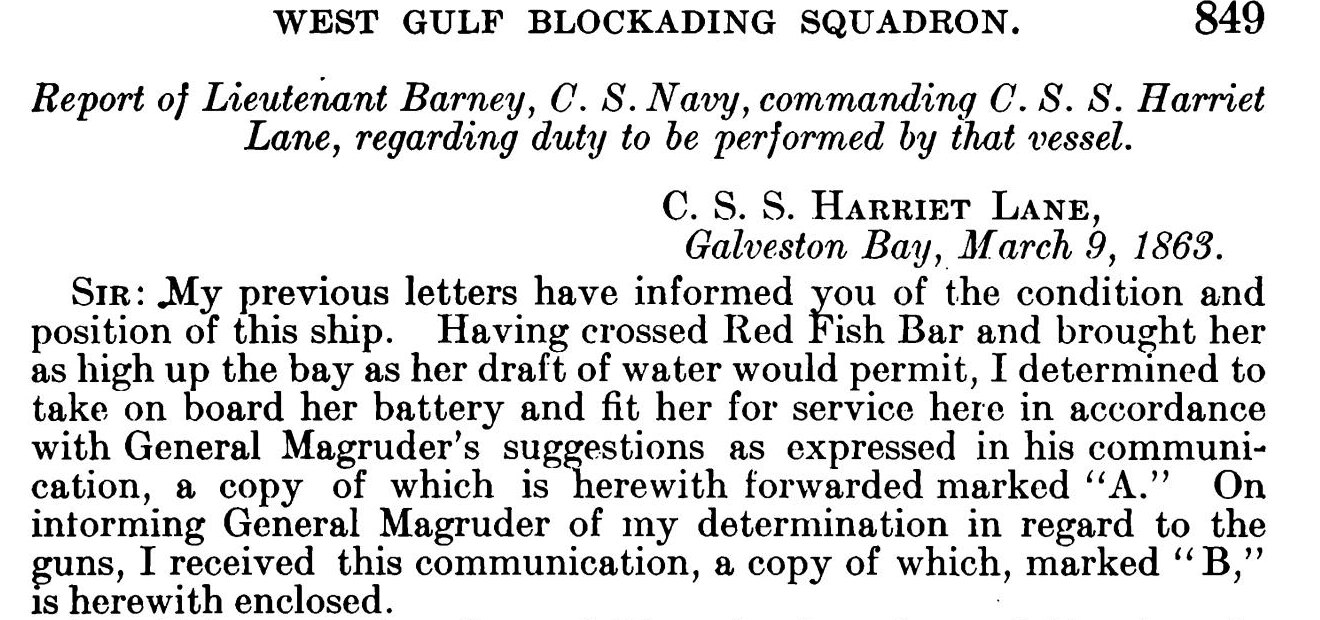
This is worth being careful about. The 9 March letter is not a plain copy of the 19 March one, and it does not contain the answer. It is a separate document, written ten days earlier, that happens to discuss the same situation in plain English. When no key survives, that kind of outside agreement is the strongest check available, because the recovered words were not chosen to fit it.
One group refuses to resolve. 113-3-85 asks for the eighty-fifth headword in a column that holds 35, so there is no such word and the address cannot be followed as printed. The explanation that fits is that Barney wrote 8s, for position 8 plus the plural, and that it reached print as 85. Position 8 is GUN, so the sentence reads SHIP GUNS, which matches the 9 March report’s repeated talk of the ship’s guns. But the printed page really does read 85. Three readings of the scan agreed on that, and nothing in the image supports 8s.
So that word is logged as conditional, resting on a reading of 85 as 8s that nobody has confirmed against the manuscript. Seventeen of the eighteen groups resolve mechanically. The eighteenth does not, and is not going to be written up as though it did. The problem page says what would settle it.