Compete to crack secrets lost to history—for fun, clout, and (no) profit
Problems › 24
| Date | Event |
|---|---|
| 2026-08-14 | Problem registered |
| 2026-08-18 | Solution 24-1 submitted by @offgramercy |
| 2026-08-18 | Solution 24-1 accepted, status set to NEW_SOLUTION, lifecycle CLOSED |
Edwin De Leon was the Confederate government’s propaganda agent in Europe, with $25,000 of secret service money to spend on the European press. He wrote numbered despatches home to the Secretary of State. Nos. 1 to 12 are in plain English, and are online in full: his mail was taken at sea in the autumn of 1863 and printed by the other side. The next two despatches are not in plain English.
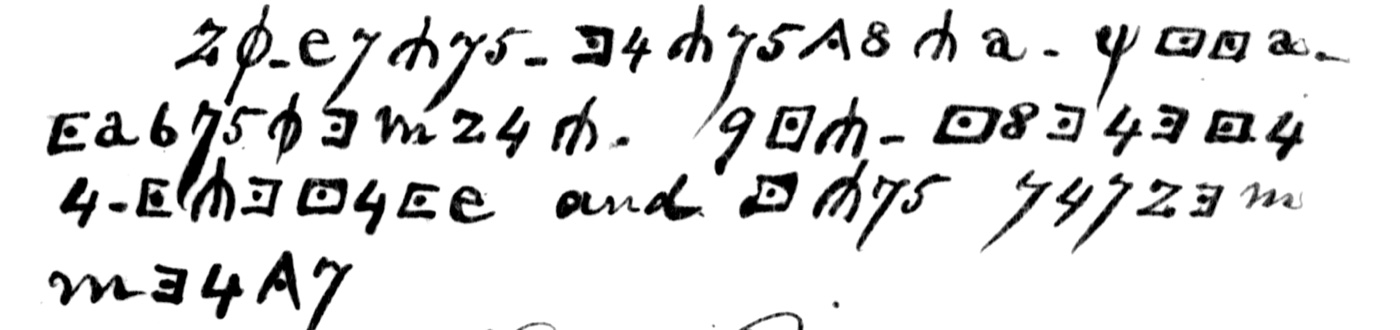
Nos. 13 and 14 carry three passages of geometric marks — dotted boxes opening in different directions, a trident, a caret with a dot, phi and psi, and the arabic numerals 2, 4, 5, 6, 7, 8 and 9 used as ciphertext. About 197 marks survive across the two documents. The first passage reappears in the second despatch, so the raw count on the film is higher than the count of distinct text.
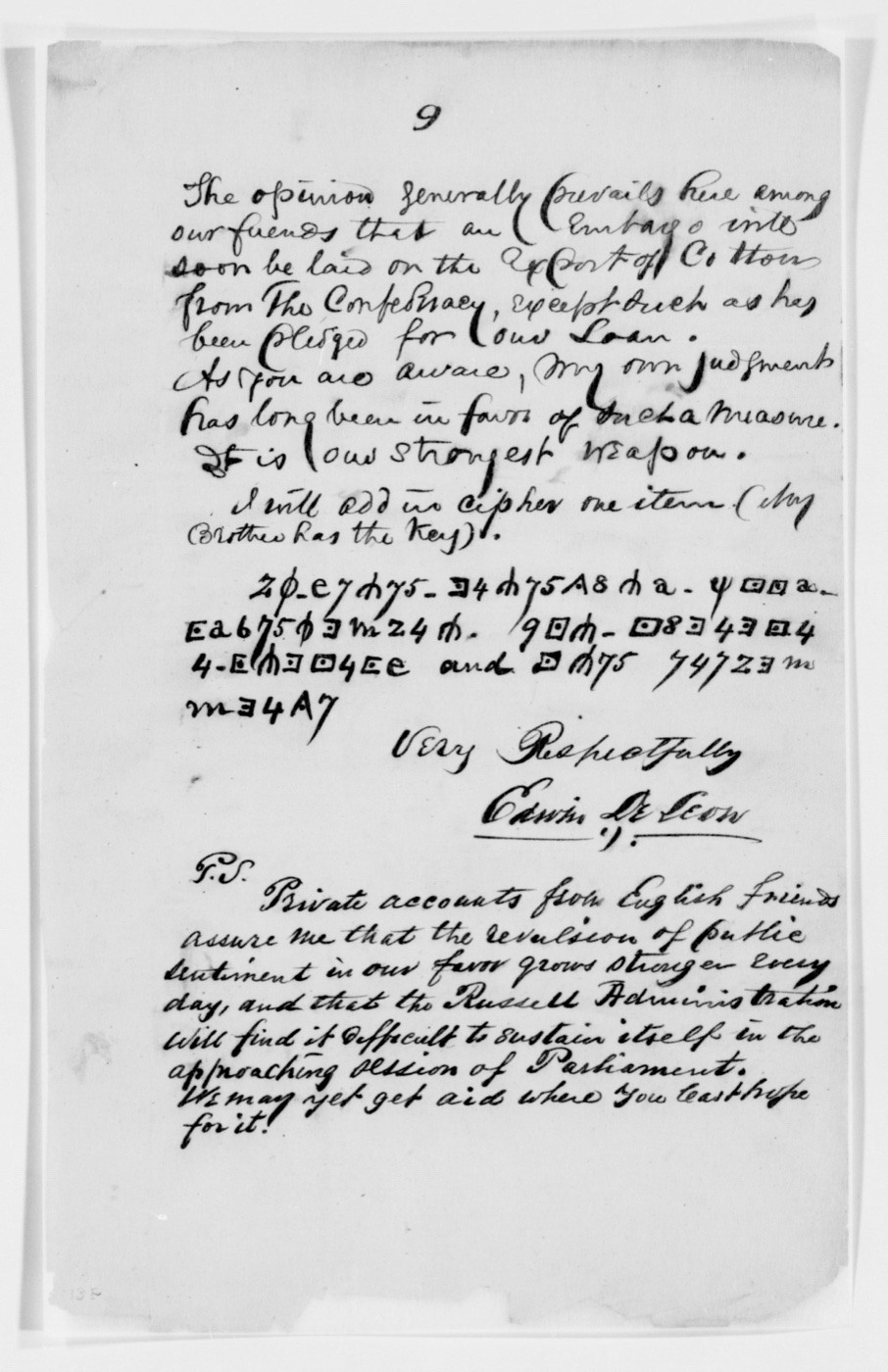
He announces the cipher in the middle of the page, in clear:

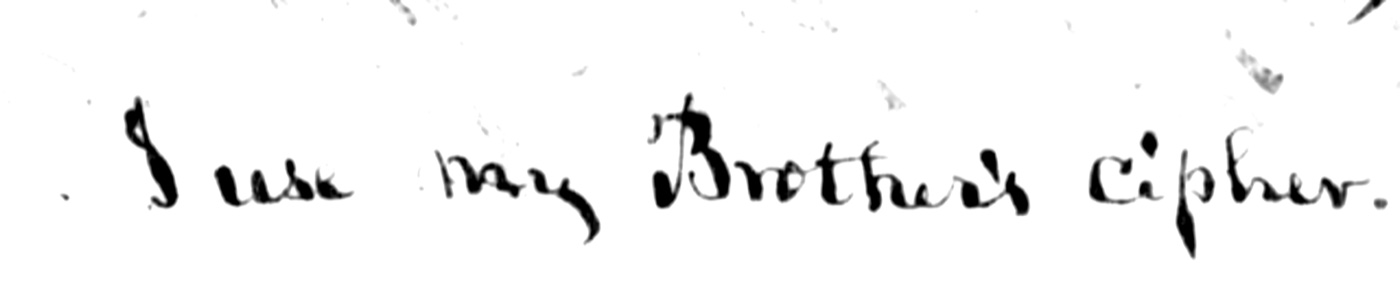
And says it again in a postscript two frames later, “I use my Brother’s cipher.”
No matching key has been located in the records examined. The manuscript, its repeated passages and its own clear remarks are the starting material for an attempt.
Transcript of frame 97, set as the page. Cipher in bold mono.
It is our strongest weapon.
I will add in cipher one item. (My Brother has the Key.)
Zφ e7⋔75 ⊐4⋔75^8⋔a ψ⊡⊡a ⊏a675⋔⊐mZ4⋔ 9⊡⋔ ⊡8⊐4⊐⊡4 4⊏⋔⊐⊡4⊏e and ⊡⋔75 747Z⊐ m⊐4^7
Very Respectfully
Edwin De Leon
P. S.—Private accounts from English friends assure me that the revulsion of public sentiment in our favor grows stronger every day …
Reel 9 frame 97, Despatch No. 13, Paris, 23 December 1863. LOC Pickett Papers MSS16550. The cipher line is set in the nearest ASCII and Unicode shapes to what is on the page: it is a rendering, not a facsimile, and the manuscript is the witness. One word inside the stream, and, is written in ordinary English.
Library of Congress, Confederate States of America Records — the Pickett Papers, the captured Confederate State Department archive — MSS16550.
| Frame | What is on it |
|---|---|
| reel 9 / 97 | Despatch No. 13, Paris, 23 December 1863; one passage, four lines |
| reel 9 / 102 | Despatch No. 14, Paris, 20 January 1864; the first passage repeated, then two more |
| reel 9 / 104 | The postscript naming whose cipher it is |
| reel 33 / 592 | Duplicate copy of No. 13 |
| reel 33 / 594 | Duplicate copy of No. 14 |
The reel 33 copies provide another written rendering to compare with reel 9. Their copying relationship is not established: agreement can preserve a mark, but can also carry forward an error from a shared exemplar.
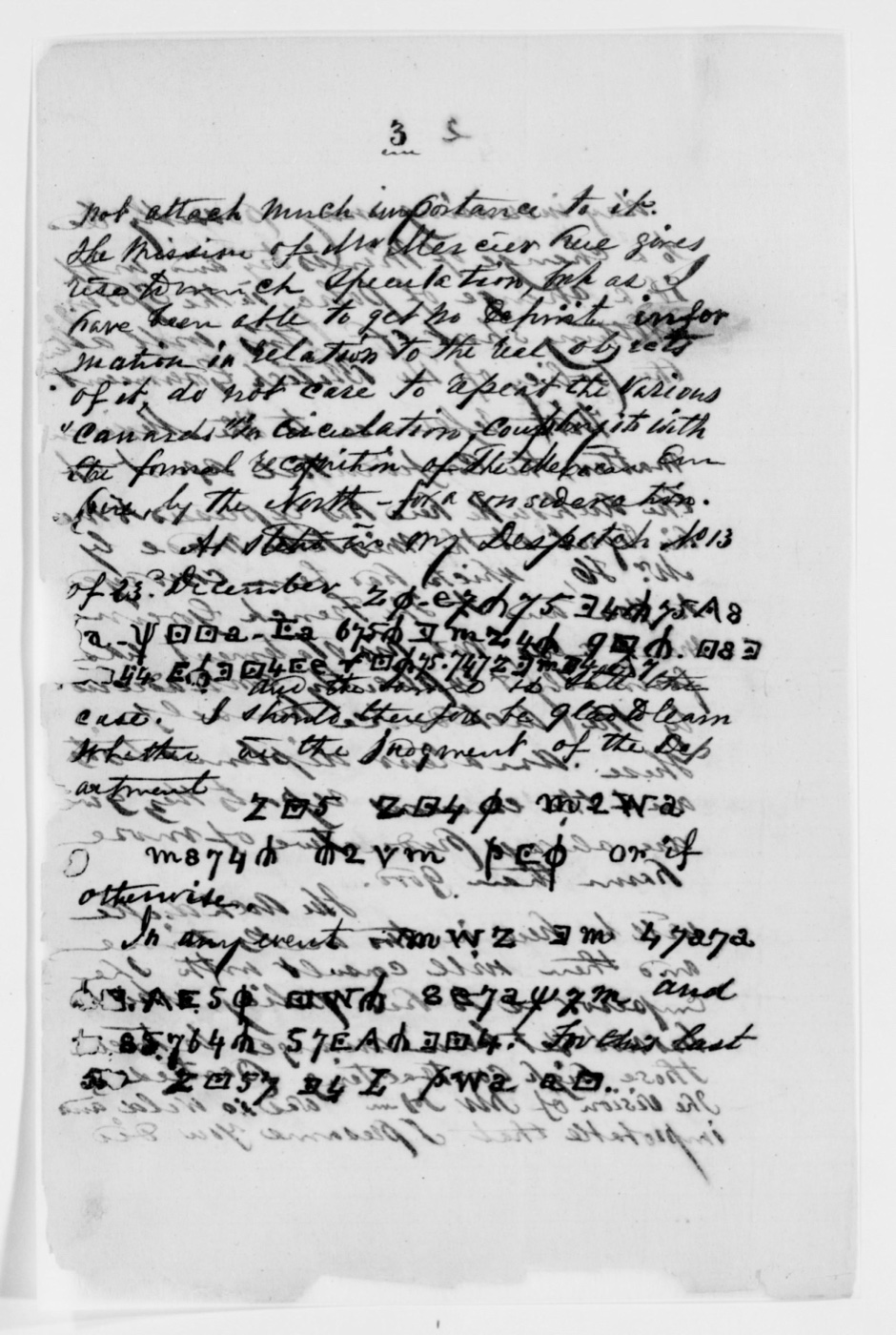
Passage B, typographic rendering of the recorded marks
Z⊡5 Z⊡4φ m2Wa 9 m874⋔ ⋔2V̇m p⊏φ
Passage C must be consulted in the image above. A dependable complete sign-by-sign transcription is not available here; its damaged ending has not been filled from a reading.
Three passages, about 197 marks, two witnesses each, and no key. That is the problem.
| # | Solution | By | Status |
|---|---|---|---|
| 1 | Solution 24-1 Reads the principal passages, with a rare mark and the damaged tail still unresolved Still open: one rare mark and the damaged ending remain unresolved. More material in this hand, a surviving alphabet, or a clearer image could settle them. The solution includes the September review of the rare forms. Blocked on: a cleaner exposure of frame 102. The tail of the third passage does not resolve; the page has bled through from the other side and the last marks are not legible enough to count as read. A better image of that frame, or of its reel 33 duplicate, would settle whether they are damaged or simply rare. Submit a solution if you can resolve it. |
@offgramercy | ACCEPTED |
More than one solution can be right. A later one may be cleverer, or reach the same reading by a better route, and it gets its own number and stays on the record. The first accepted reading keeps its place in the order.