Compete to crack secrets lost to history—for fun, clout, and (no) profit
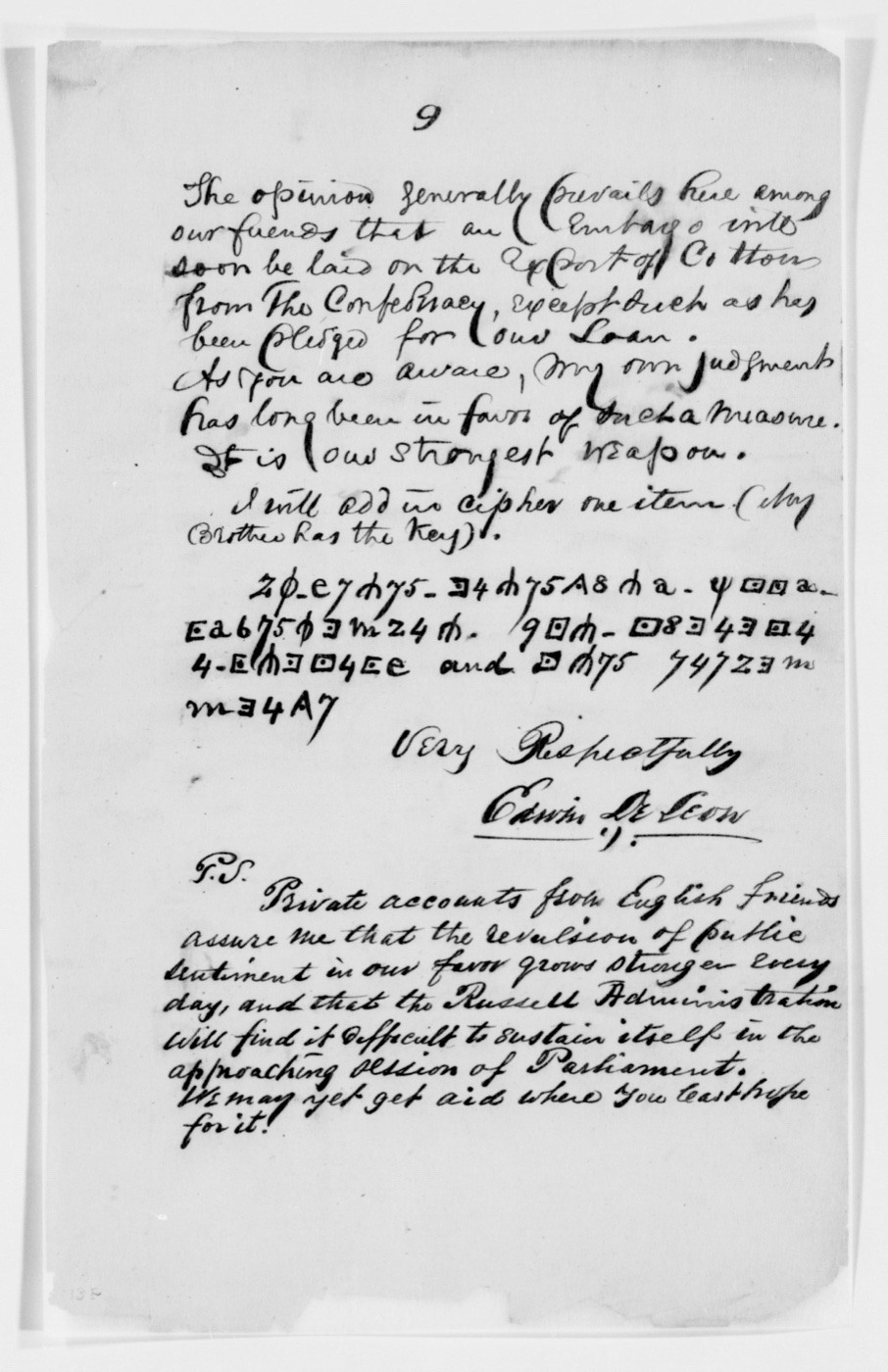
Start with only the marks. Not the history, not the man, not the file. Four lines on frame 97, two more passages on frame 102, about 197 marks in total.
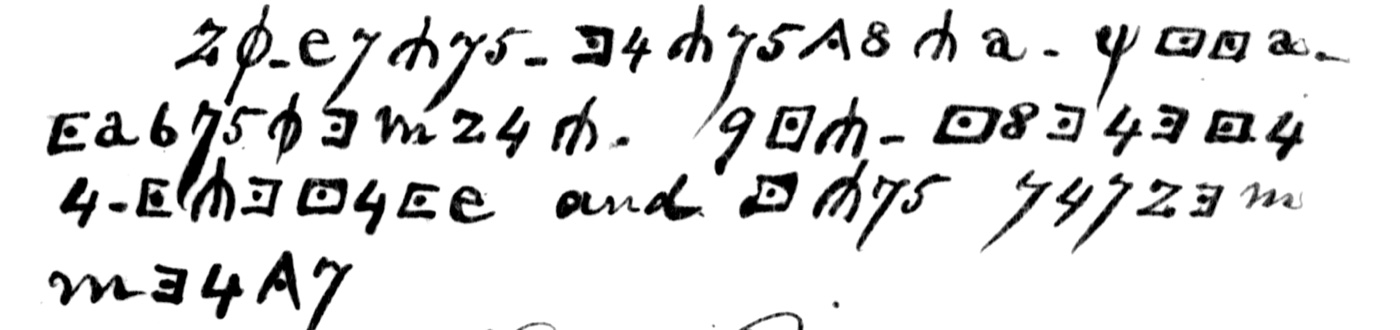
Three things are visible straight away, and all three are gifts.
The marks are spaced into words. He put gaps between groups exactly where a writer puts gaps between words. Most historical ciphers are written out in blocks of five precisely to take that away from you. He did not.
He left some words in plain English inside the cipher stream. On frame 97 the word and is written out in ordinary letters between two enciphered groups. On frame 102 he does it again, more than once. Those words are free: they tell you where the sentence breaks are, and they tell you he was not being careful.
The inventory is small and the marks repeat. Count the distinct shapes and you get low twenties. That suggests an alphabetic interpretation worth testing. It does not prove a strict one-to-one mapping: variant handwriting may give one letter more than one form. If the interpretation is right, the patterns of repeated letters in words should help.
The textbook first move on a one-mark-one-letter cipher is to count the marks and match the counts against the frequencies of English letters: the commonest mark is probably E, the next probably T, and so on.
Frequency ranking alone did not settle this short sample. The counts suggested a plausible E, but the remaining assignments required word patterns and checks across the passages.
So the counts go in a drawer and you look at word shapes instead.
A word’s shape is its pattern of repeats, written without caring what the letters are. PEOPLE is ABCADB: first letter comes back at position four, second at position six. That shape belongs to the word whatever alphabet it is written in, because enciphering it one-for-one moves the letters but not the repeats.
On the third line of frame 97 there is a seven-mark group whose shape is ABCDCAD : a mark, a second, a third, a fourth, then the third again, the first again, the fourth again. Written out, ⊡8⊐4⊐⊡4.
Run that shape against an English word list — 235,974 words — and ask which seven-letter words repeat their letters in exactly that arrangement. Exactly one comes back: OPINION. O-P-I-N-I-O-N: first and sixth the same, third and fifth the same, fourth and seventh the same. That is the shape, and it was the only match in the tested list. A word list is not the whole language; names, uncommon forms and historical spelling remain possible alternatives.
That nominates four letters: O, P, I, N. The surrounding words and the later checks must still establish whether this word-list candidate belongs here.
The next group is eight marks, and it starts with the mark now known to be N and puts I, O and N in its second half: 4⊏⋔⊐⊡4⊏e reads N _ _ I O N _ _.
For most writers that is a puzzle. For this one it is barely a step. His job was paying European newspapers for favourable coverage, and the group before it is OPINION. L’Opinion Nationale was a Paris daily of exactly the kind he was buying. NATIONAL fits the gaps, and brings A, T and L with it.
Seven letters in, and the sentence around them starts to come apart on its own. The three-mark group before OPINION is 9⊡⋔ — _ O T, and in that sentence there is only one thing a man does to a newspaper. From there it is bookkeeping: fix a letter, propagate it through every group that mark appears in, see which half-finished words can close only one way, and go round again.
A chain of inference like that is convincing to the person holding the chain and to nobody else. So it was run again from the other end, by a method that knew none of it.
Hill-climbing on quadgram scores. Take a random alphabet. Decipher with it. Score the output on how often its four-letter sequences occur in English — THAT, TION, OFTH score high, XQZK scores nothing. Swap two letters at random; keep the swap if the score improves, discard it if not. Repeat until nothing improves, then start again from a fresh random alphabet so you do not sit in a local maximum. 300 restarts. No cribs, no OPINION, no knowledge that the word list had been consulted at all.
The scoring run agreed on several assignments. At the seven-mark group it printed OWINION, agreeing on O, I and N but not independently settling P. The earlier inventory records the P-mark seven times; the disagreement cannot be explained by saying it occurs only once.
The two approaches provide different checks, but their agreement is incomplete. The surviving passages and later documentary comparisons carry the remaining evidence.
| Mark | What it looks like | Letter |
|---|---|---|
| 7 | the figure 7 | E |
| 4 | the figure 4 | N |
| ⋔ | trident | T |
| ⊡ | box with a dot | O |
| ⊐ | box open on one side, dotted | I |
| V̇ | V with a dot | I |
| ⊏ | box open on the other side, dotted | A |
| 5 | the figure 5 | R |
| a | cursive a | D |
| m | cursive m | S |
| e | cursive e | L |
| p | cursive p | W |
| Z | angular Z | M |
| 2 | rounded 2 | H |
| 8 | the figure 8 | P |
| 9 | the figure 9 | B |
| 6 | the figure 6 | V |
| W | W | U |
| ^ | caret with a dot | C |
| φ | phi | Y |
| ψ | psi | G |
| — | I-beam | unassigned |
| – | old crossing-stroke ID; compatible with p-like form | p-like variant candidate; inherited W |
Marks are set here in the nearest ASCII and Unicode shapes; the manuscript is the witness for what is actually on the page.
Two traps in reading it. An angular Z and a rounded 2 look alike in a hurried hand and are different letters, M and H. Merging them was the first inventory’s mistake, and the symptom was a corpus that appeared to contain no H at all. Separately, phi and psi are easy to confuse and carry Y and G; reading one for the other turns PLEDGES into PLEDGMS, which is how that error was caught.
The recovered text uses shortened spelling. Across about 90 aligned positions, the earlier analysis counted 16 deletions, no insertions and no substitutions. That is a pattern in the checked sample, not proof that the writer never made a different error.
The checked examples do not fit indiscriminate vowel loss, final-letter loss or inserted nulls. The observed contractions reduce the number of marks written. Whether saving effort was the writer’s purpose is not established by the text.
Italics are words he wrote in plain English inside the cipher stream.
Zφ e7⋔75 ⊐4⋔75^8⋔a ψ⊡⊡a ⊏a675⋔⊐mZ4⋔ 9⊡⋔ ⊡8⊐4⊐⊡4 4⊏⋔⊐⊡4⊏e and ⊡⋔75 747Z⊐ m⊐4^7
MY LETER INTERCPTD. GOOD ADVERTISMNT. BOT OPINION NATIONAL and OTER ENEMI SINCE
My letter intercepted. Good advertisement. Bought L’Opinion Nationale — and other enemies since.
He is telling his own government that having his correspondence splashed across the Northern press did him a favour, and that he has been buying up Paris papers that used to attack him. Note the plural: and other enemies since. What BOT covers is worth being careful about, because the cipher does not say. His fund was for placing Confederate material in the European press, which in practice meant subsidies, retainers to editors and paid insertions. Buying the titles outright would have cost far more than $25,000 for the whole of Europe. The natural reading is that he bought their support rather than the papers, but the word on the page is BOT and it should not be pushed further than that.

Z⊡5 Z⊡4φ m2Wa 9 m874⋔ ⋔2V̇m p⊏φ
MOR MONY SHUD B SPENT THIS WAY
SUM IS NEDED TO CARY OUT PLEDGES and to PREVNT REACTION. For this last 500 MORE …
That reads cleanly down to PREVNT REACTION. For this last 500 is written in plain English on the page. After it come a handful of marks that do not resolve, and they are left as they are. Reading the ending as a request for the balance in fifty-pound notes is an inference from his brother’s wording, not something those last marks give up.
The alphabet and the readings above came out of the ciphertext. Two contemporary translations were found in the file afterwards, both from February 1864, and both attributed to the brother named on frame 97, the man who held the key. Their filed copies do not by themselves authenticate the writer’s hand.
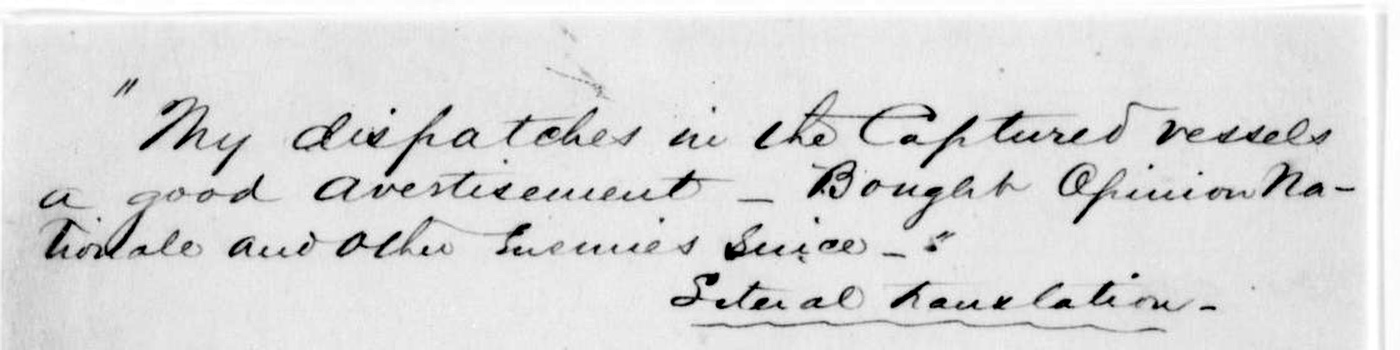
The first passage matches outright. The second is the strong one: on frame 595 the filed rendering places English above the cipher line, group against group, so the two can be laid side by side mark for mark.
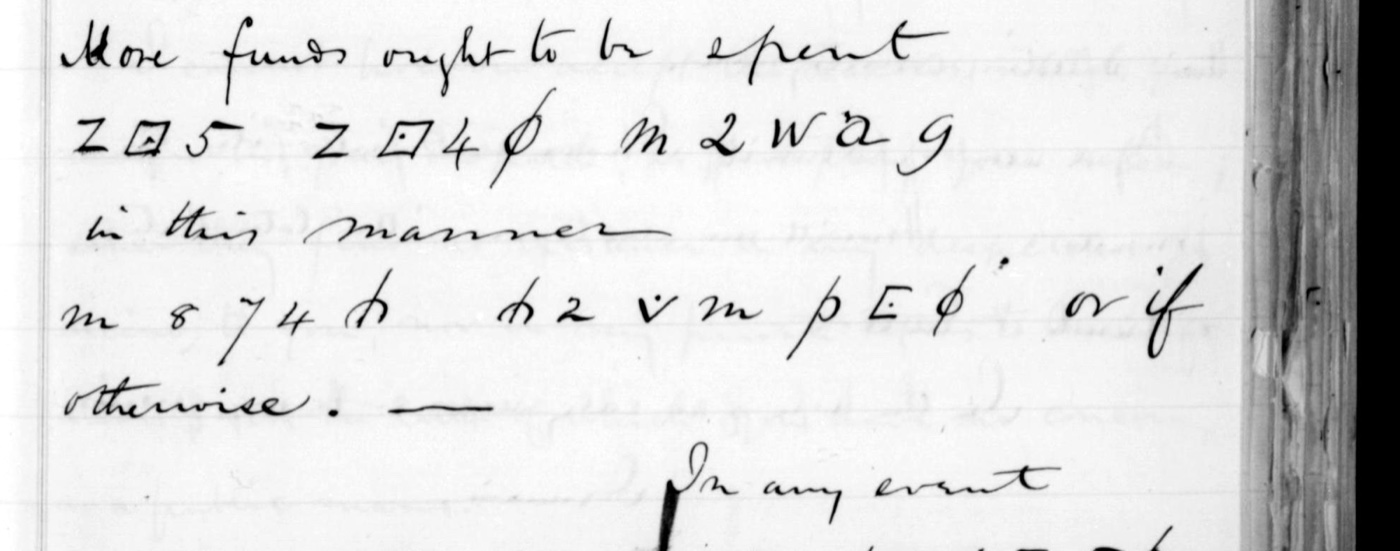
He was not solving anything. He had the alphabet, and produced a reading when the State Department asked him for one. That is exactly what makes him a good control rather than a rival claim: an independent witness with access to the ground truth, who never saw this work and could not have been influenced by it.
It is also worth noticing what the existence of those slips means. The brother worked in the Navy Department. When No. 13 reached Richmond, the State Department’s chief clerk had to write to another department to ask what it said. That office did not have the private alphabet to hand — which is not the same as proving nobody in it could ever read this.
The translations are paraphrase, not a mechanical transcript. The brother writes “funds” where the cipher says MONY, and “in this manner” where it says THIS WAY, and says so himself: “as near as I can make it.” He never wrote down a single mark-to-letter mapping in either document. So the translations confirm sense and, for a few rarely-used marks, settle a letter — but they are not a key, and they cannot be used to check the alphabet mark by mark.
The I-beam remains unassigned. The September review found the old crossing-stroke form compatible with another way of writing the p-like mark. It does not establish a second distinct unknown letter. The historical transcription IDs remain unchanged.
Passage C’s tail is not read. The last marks are illegible on the film and are recorded as unresolved rather than filled in from the paraphrase.
The September review checked the Z/2 distinction locally. Four paired positions in passage B retain two angular and two curved forms in both copies. This supports the shape distinction there, but does not independently recover the M and H values. Other forms overlap, so the width of a top bar cannot classify the whole alphabet.
A claimed Y-for-T copying error has been withdrawn. The corresponding arches and joins differ across the surviving images, and one counterpart is obstructed. They do not prove an intended phi or establish that Edwin copied ciphertext rather than enciphering the text again. Textual reuse is supported; the copying process remains unknown.
The 6 September graphical review examined 35 selected positions in five held images. It was conducted with the reading already known, and is not an independent blind recovery. The phi/psi inventory has not been fully recounted, and neither the I-beam nor passage C’s tail has been settled.
The content of these despatches was never lost. The key-holder’s translations were filed with them and have been in the archive throughout. What was lost is the alphabet: no written key was located in the checked surviving documents. That is what has been rebuilt, and unlike the translations it supplies a testable starting key for further material in this hand, subject to the remaining rare-form and source uncertainties.
The catalogue therefore files this as NEW_SOLUTION and not as SYSTEM_RECOVERED. The evidence is of the stronger kind — a recovered system, checked against a key-holder — but the residue is real, and the record follows the residue. See the problem page for what would close it.