Compete to crack secrets lost to history—for fun, clout, and (no) profit
Problems › 50
| Date | Event |
|---|---|
| 2026-08-24 | Problem registered |
| 2026-08-25 | Solution 50-1 submitted by @offgramercy |
| 2026-08-25 | Solution 50-1 accepted, status set to NEW_SOLUTION, lifecycle CLOSED |
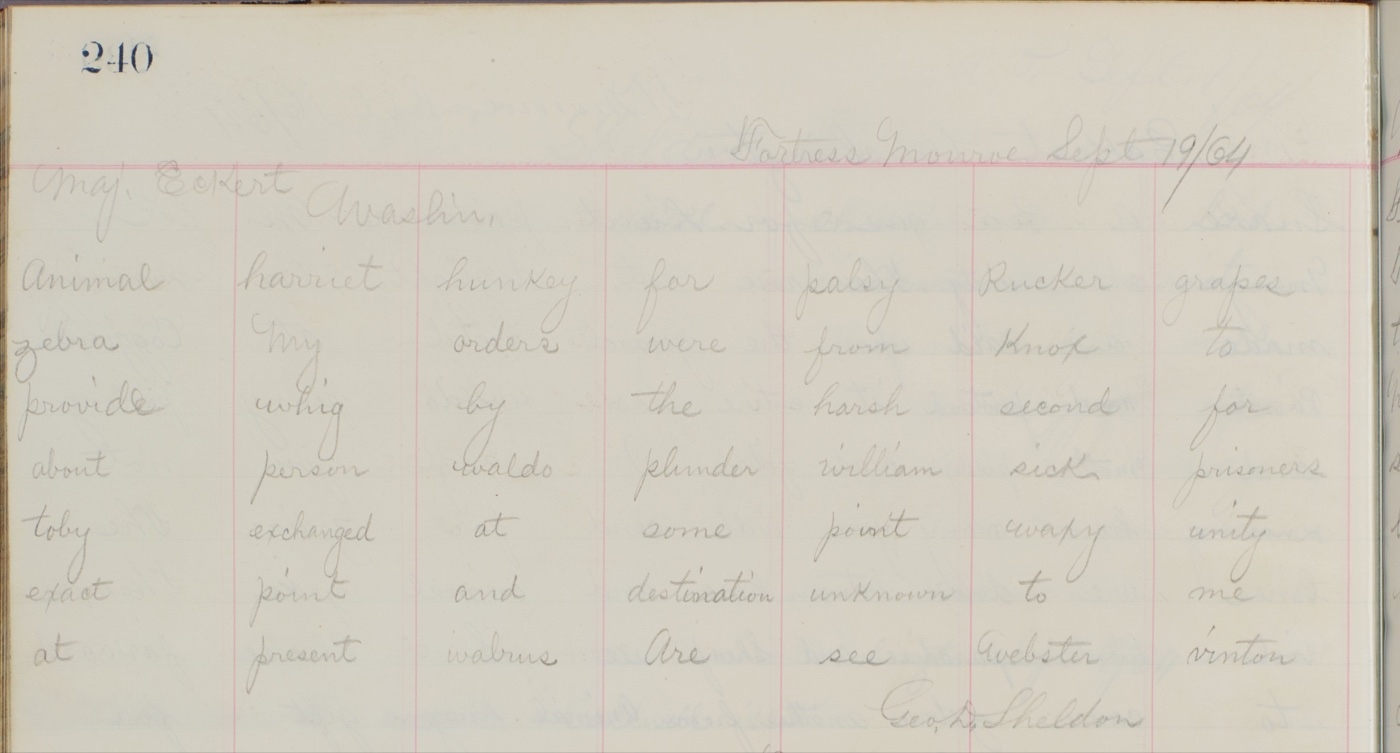
The Union army kept its Fort Monroe telegraph traffic in bound ledgers ruled into seven columns, and the clerks entered each message into those columns one word to a cell, in the order it went on the wire. One volume covers February 1864 to April 1865. Page 240 of it carries two messages. The first is headed Fortress Monroe Sept 19/64, addressed Maj. Eckert, Wash’n., signed Geo. D. Sheldon, and runs to forty-nine cells between the address and the signature.
Every one of the forty-nine holds an ordinary English word. No numbers, no symbols, no blanks, no underlining, no brackets. Read across the rows and the page behaves like a sentence that keeps losing its footing: a clause starts, a word turns up that does not belong in it, the clause carries on. It sits somewhere between a sentence and nonsense, and one hand wrote all of it at one size.
So the first question here is not what the message says. It is which of these forty-nine words are carrying meaning that is not their own. The page will not tell you. No column is reserved for one kind of word, no cell is marked, and nothing separates a word the sender meant from a word he wrote in place of the one he meant. You can sort them by eye, and any solver will, but the sort is a guess before it is anything else, and it is the first place a reading can go wrong. Nothing guarantees that the cells which look out of place are the only ones doing hidden work, or that the ones reading naturally are innocent. Making that division, and then defending it, is the problem rather than a step you take before starting it.
The record helps with none of that. The volume carries no key. The Huntington’s own catalogue transcription reproduces the words on the page and stops there. No clear copy of this telegram, no contemporary translation of it, and no prior reading of it are on record.
Transcript, set as entered in the book. Nothing is marked, because nothing on the page is marked: every cell is rendered the way the clerk wrote it.
Fortress Monroe Sept 19/64
Maj. Eckert
Wash’n.
| Animal | harriet | hunkey | for | palsy | Rucker | grapes |
| zebra | My | orders | were | from | knox | to |
| provide | whig | by | the | harsh | second | for |
| about | person | waldo | plunder | william | sick | prisoners |
| toby | exchanged | at | some | point | waxy | unity |
| exact | point | and | destination | unknown | to | me |
| at | present | walrus | Are | see | Webster | vinton |
Geo. D. Sheldon
Huntington Library, Thomas T. Eckert Papers, mssEC 25, page 240. Page scan. The heading, the address line and the signature stand outside the forty-nine cells. They are the ledger’s own framing, and they run to eleven further words.

| # | Solution | By | Status |
|---|---|---|---|
| 1 | Solution 50-1 Reads all forty-nine cells, two of them recorded as arguments rather than as results Still open: nothing in the message. Every cell is read. What is not closed is the search behind the claim that nobody had read it before: three named public interfaces returned rate limits, challenges and refusals rather than results, and those attempts are disclosed rather than counted as searches that came back empty. An attributable earlier reading of this telegram, in any form, retires the claim. Submit a solution if you can produce one. |
@offgramercy | ACCEPTED |
More than one solution can be right. A later one may be cleverer, or reach the same reading by a better route, and it gets its own number and stays on the record. The first accepted reading keeps its place in the order.