Compete to crack secrets lost to history—for fun, clout, and (no) profit
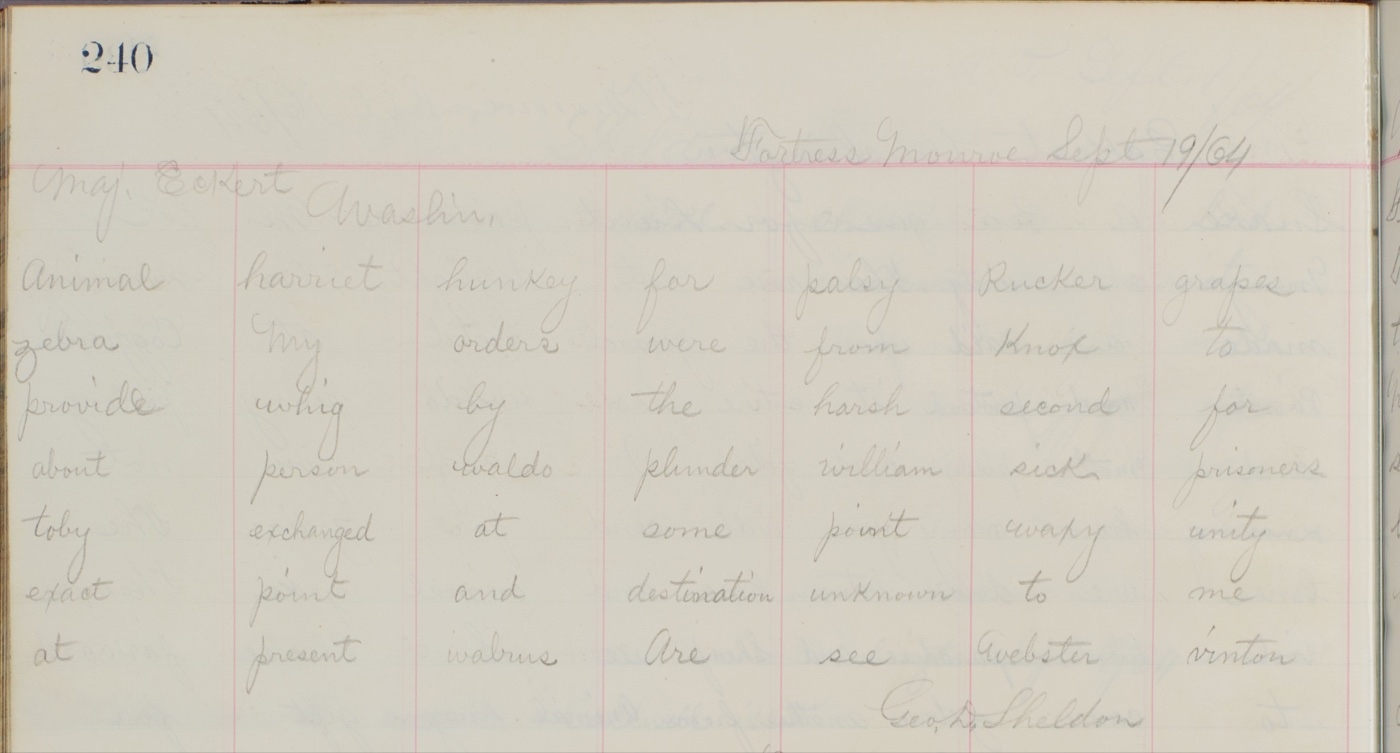
Start with only the page[1]. Seven ruled rows of seven cells, forty-nine words, with a heading, an address and a signature outside them. Every cell holds an ordinary English word, and nothing on the page tells one cell from another. State that plainly, because it is the whole difficulty. Whatever is hidden in this telegram is hidden inside words that look exactly like the words next to them.
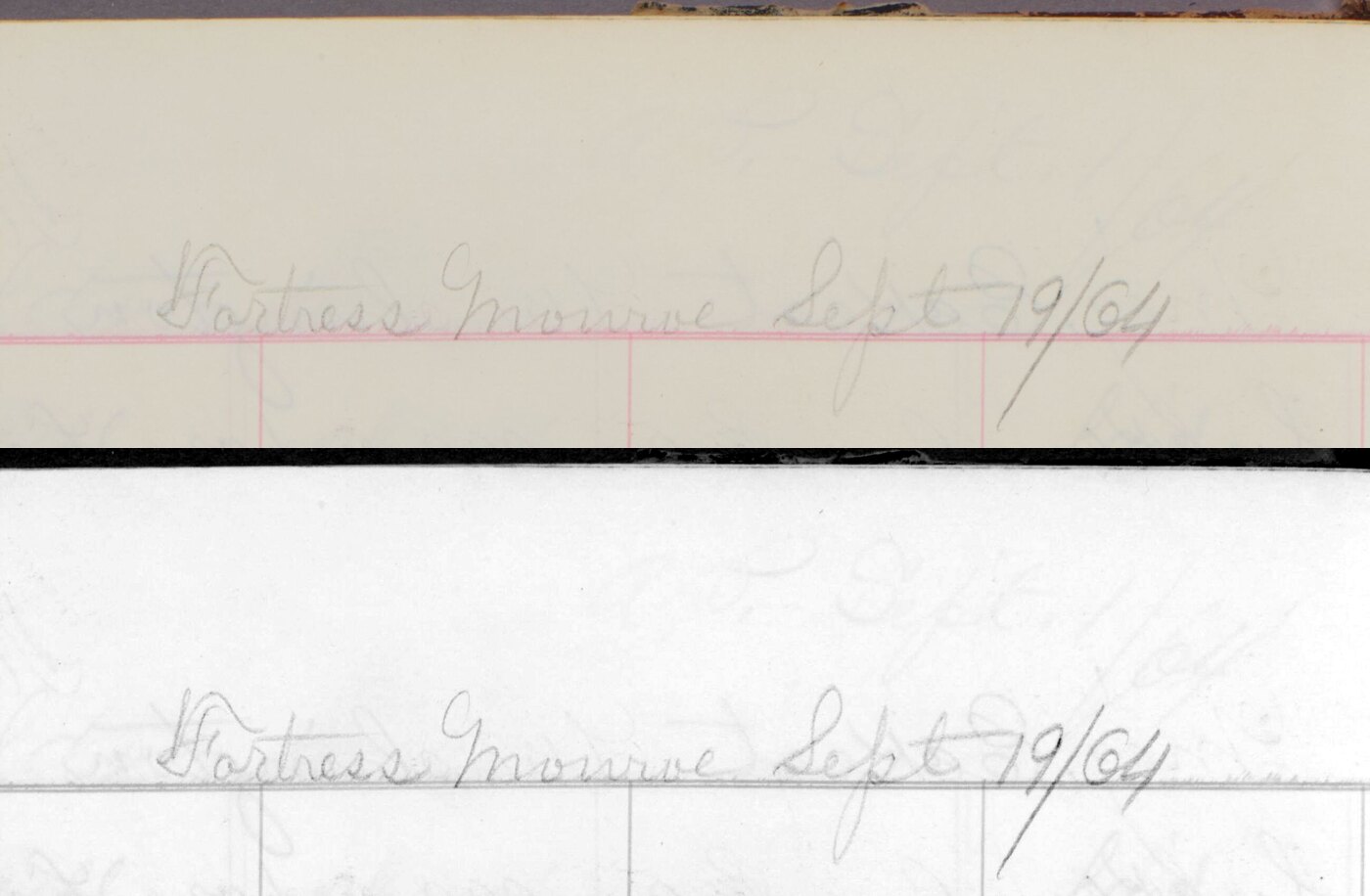
The heading is one of the few things on the page written in clear. It gives the place the message was filed and the day, and on the scan[1] it is faint pencil. Getting it to read at all takes a contrast adjustment, which is worth stating, because the date and the place carry weight later on this page.
Read across and the sense comes and goes.
zebra My orders were from knox to provide whig by the harsh second for about person waldo plunder william sick prisoners
Some of that is a quartermaster writing a sentence and some of it is not, and there are two ways to get the division wrong. Treat all forty-nine cells as substitutions and there is no way into the message at all, because a substituted word gives nothing away. Treat only the odd-looking cells as substitutions and you have already decided something the page never told you, on the strength of how the words strike a modern ear.
The honest first move is to nominate suspects rather than to split the page in two. Three tests do the nominating, and none of them settles anything alone.
Grammar. English word order is a hard constraint and a telegram obeys it. from knox to puts a proper name where the sentence wants a person or a thing. provide whig puts a name where a direct object belongs. by the harsh second puts an adjective where a number belongs. A cell that fills the wrong part of speech for the slot it sits in is a suspect.
Vocabulary. Telegraph traffic in this volume has a house register: military rank, transport, dates, places, numbers. Words like hunkey, vinton and toby are not words a quartermaster puts on a wire in 1864. This is the weakest of the three tests, and it is weak in a way worth naming, because person, plunder, grapes and william are all ordinary enough to pass it and all four are standing in for something.
Position. A telegram has fixed furniture. It opens with the place it was filed and the time, it names the man addressed and where he is, and it closes with a name and a title. Whatever occupies one of those slots is doing that job whatever it looks like. The first three cells of row one stand where a dateline goes. The last row stands where a signature goes.
Run all three tests and the result is a list of suspects, not a division of the page. Cells 23 to 26 read person waldo plunder william, four ordinary nouns in a row, and all four stand for something else. Cells 27 and 28, immediately after, read sick prisoners and mean sick prisoners. Nothing in the ink, the spacing or the ruling separates cell 26 from cell 27. Only a key does.
The suspect list is still worth having, because three things about the system follow from it before any book is opened.
Nothing is transposed. The clear stretches run in the order a man would say them, and the ruled columns are the ledger’s, not the cipher’s. Whatever is happening happens one cell at a time, in place.
The suspect cells sit exactly where the facts are. The place and time the message was filed, the rank of the man addressed, the city he is in, the name of the officer whose orders these were, the thing to be provided, the deadline, the two numbers, the destination, and the sender’s own name and title. A reader in 1864 without the key could tell you what kind of message this was and not one operational fact in it.
Even the punctuation is substituted. zebra and unity fall precisely where two sentences end. That is a strong hint about the shape of the system. Something that has an entry for a full stop is a book with a list in it, not a rule that scrambles letters.
The temptation with a message like this is to make the division, read the clear stretches, and say you have read the telegram. You have not. Every fact the telegram was sent to carry is in a suspect cell, and a suspect cell carries no internal evidence at all. person and plunder are numbers, and nothing about the letters p-e-r-s-o-n says 5 rather than 9 or 500.
Nor is there anything to attack statistically. Forty-nine cells is a tiny sample, every substituted word in this message occurs once, and the substitutions are arbitrary by design: the whole point of a word list is that the written word and the meant word have no relation. Frequency counting, pattern words, hill climbing, all of the machinery that breaks a letter cipher has nothing to bite on here. That machinery also cannot tell you where to draw the line between the two kinds of cell, which is the prior question.
For this telegram, a paraphrase of the clear stretches is insufficient. Each proposed reading needs a public-table row, separately checked traffic precedent, or an explicit local argument.
This is where Problem 50 differs from Problems 14 and 24, and the difference should be stated plainly rather than dressed up. Problem 14 identifies a surviving dictionary printing from documentary clues and coordinates; Problem 24 reconstructs a symbol alphabet. Here the working table survives in print, in the same archive as the telegram, digitised and public[2].
The operative table family is Stager’s Cipher Book No. 1, the standard United States Military Telegraph system, named for Anson Stager, who built it. The Huntington holds a run of sister copies and one of them, mssEC 45, is complete and imaged. Fixing the family to this traffic was not a guess from a title. It came from a dense join across several independent classes of entry at once: a twenty-nine value numeral insert, paired place aliases, ordinary lexical entries, punctuation and operators, time entries and titles. Two messages in the same Fort Monroe volume, a request and its next-day reply, have exact clear copies in the National Archives, and those pairs anchor the join from the other end. They are Problems 48 and 49.
The book is a list, alphabetised, and each line runs three ways across the opening. The plain word is written by hand in the middle. To its left and its right stand two printed words picked for having nothing to do with it, either of which may be sent in its place. Give the clerk two choices for every entry and the same word will not appear the same way twice in a day’s traffic.
That layout also answers the question the page itself refused to answer. An exact outer-word match nominates a table application; it does not decide one. The table section, source position, previously checked traffic and local role determine whether that entry applies. A word can be listed and still be literal here, as Webster is below; an unlisted form can still depend on a recorded traffic convention.
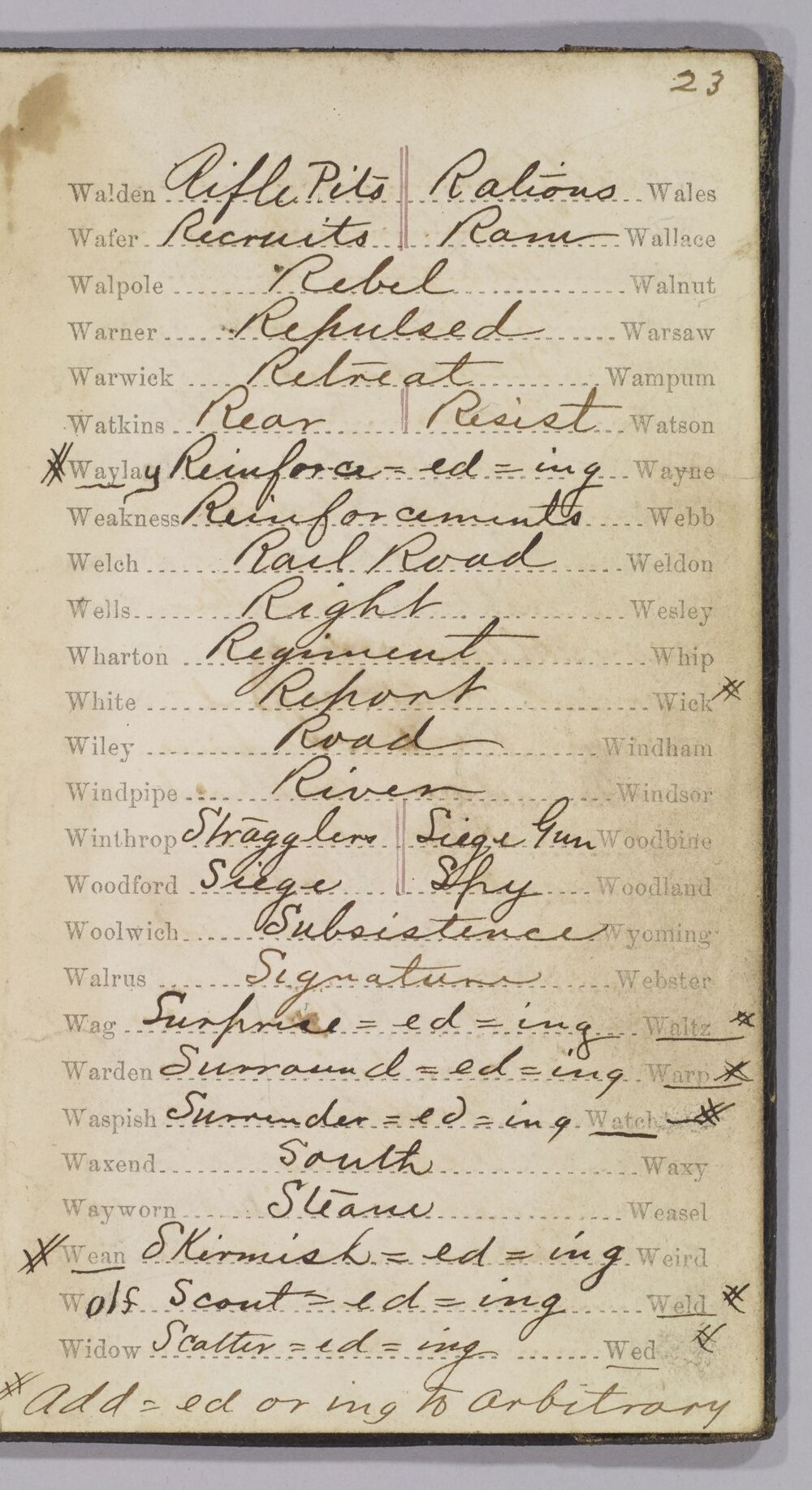
Forty-eight of the forty-nine cells came out of positions that were already fixed, either by an entry recorded from the public book or by an earlier message whose clear copy survives. The last one, waxy, did not. It resolves at page 23, row 22, right hand column, against the plain word South[2], and it completes the clause to be exchanged at some point South.
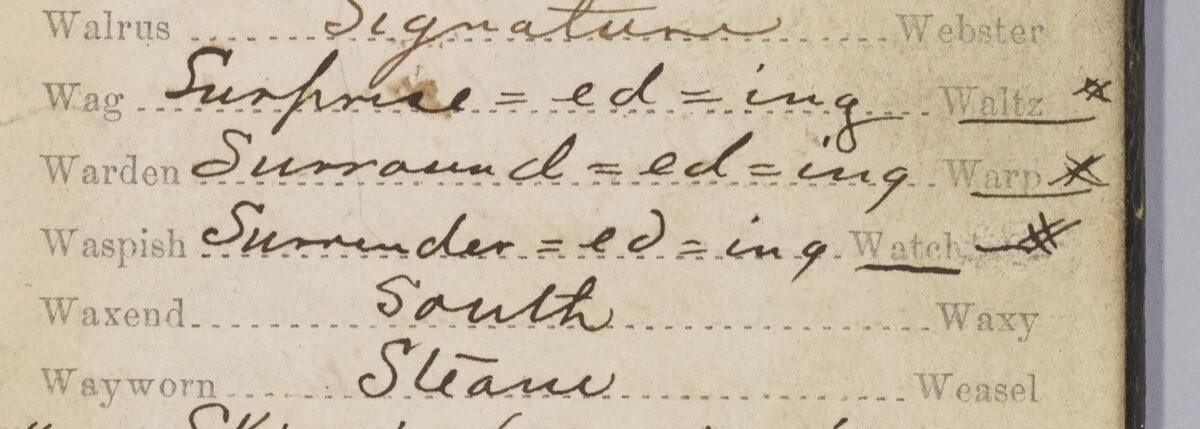
Look four lines above it. Walrus and Webster are the two printed words standing either side of Signature. Both of those words appear in the last row of the telegram. That collision is dealt with below, and it is the one place in this message where the book alone gives the wrong answer.
In clear means the word carries its own meaning and no lookup happened. Book means a position in the public table. Prior pair means a surface already fixed by a separately preserved coded and clear copy of some other message. Identity means this message only, argued below.
| # | Cell | Reads | Fixed by |
|---|---|---|---|
| 1 | Animal | FORT MONROE | book |
| 2 | harriet | 1 P.M. | book |
| 3 | hunkey | 19 | book |
| 4 | for | for | in clear |
| 5 | palsy | BRIGADIER GENERAL | book |
| 6 | Rucker | Rucker | in clear |
| 7 | grapes | WASHINGTON | book |
| 8 | zebra | PERIOD | book |
| 9 | My | My | in clear |
| 10 | orders | orders | in clear |
| 11 | were | were | in clear |
| 12 | from | from | in clear |
| 13 | knox | B. F. BUTLER | book |
| 14 | to | to | in clear |
| 15 | provide | provide | in clear |
| 16 | whig | TRANSPORTATION | book |
| 17 | by | by | in clear |
| 18 | the | the | in clear |
| 19 | harsh | TWENTY | prior pair |
| 20 | second | second | in clear |
| 21 | for | for | in clear |
| 22 | about | about | in clear |
| 23 | person | 5 | book |
| 24 | waldo | THOUSAND | book |
| 25 | plunder | 7 | book |
| 26 | william | HUNDRED | book |
| 27 | sick | sick | in clear |
| 28 | prisoners | prisoners | in clear |
| 29 | toby | TO BE | prior pair |
| 30 | exchanged | exchanged | in clear |
| 31 | at | at | in clear |
| 32 | some | some | in clear |
| 33 | point | point | in clear |
| 34 | waxy | SOUTH | book |
| 35 | unity | PERIOD | book |
| 36 | exact | exact | in clear |
| 37 | point | point | in clear |
| 38 | and | and | in clear |
| 39 | destination | destination | in clear |
| 40 | unknown | unknown | in clear |
| 41 | to | to | in clear |
| 42 | me | me | in clear |
| 43 | at | at | in clear |
| 44 | present | present | in clear |
| 45 | walrus | SIGNATURE | book |
| 46 | Are | R. | identity |
| 47 | see | C. | prior pair |
| 48 | Webster | Webster | identity |
| 49 | vinton | QUARTER MASTER | book |
Nineteen cells are fixed by the key, twenty-eight are in clear, and two are arguments about who the sender was. There are no unresolved cells. That is the division the page would not give up, and it is not the division a careful reader would have guessed: three of the nineteen are words as unremarkable as person, plunder and william, and one of the twenty-eight is Rucker, a proper name sitting in a sentence full of substitutions.

The last row is at present walrus Are see Webster vinton. walrus is the book’s marker for Signature, so everything after it is a name. vinton is Quarter Master, which the book prints as two words. That leaves three cells for the name itself.
Are and see are not entries. They are the letters R and C spelled out as they sound, which is what a clerk does with an initial when the book has no row for it. see has been observed doing exactly that in an earlier message with a surviving clear copy. Are has not, and it is recorded as an argument from context rather than as a mapping anybody may reuse.
Webster is the harder one, because the book says Webster means Signature. Taking the book literally gives Signature R. C. Signature Quarter Master, which is not a name and not a sentence. The reading here keeps Webster as a surname, on the grounds that it stands between two spelled initials and a title, in the one position in a telegram where a surname belongs, and after the signature marker has already been given. That is an override for this message and nothing more. It does not change the table.
The signature written under the ruled cells is a different thing again. The ledger has two layers. Its outer wrapper is the transmission, filed at Fortress Monroe for Major Eckert’s office at Washington and signed Geo. D. Sheldon. The message inside the wrapper is from one quartermaster to another, and the two Rucker records below address that inner correspondent directly, not Sheldon.
FORT MONROE, 1 P.M., 19. For BRIGADIER GENERAL Rucker, WASHINGTON. My orders were from B. F. BUTLER to provide TRANSPORTATION by the TWENTY second for about 5 THOUSAND 7 HUNDRED sick prisoners TO BE exchanged at some point SOUTH. Exact point and destination unknown to me at present. [SIGNATURE] R. C. Webster, QUARTER MASTER.
Colonel R. C. Webster, quartermaster at Fort Monroe, telling the depot at Washington what the transport was wanted for: about five thousand seven hundred sick prisoners, moving by the twenty-second, on Butler’s orders, to be exchanged somewhere south that nobody had yet named to him.
A reading produced by lookup is only as good as the identification behind it, and an identification is worth more when something outside the message agrees with it. Two documents do, and neither of them is a copy of this telegram.
Rucker’s own office file survives on National Archives microfilm (M504 roll 298)[4]. On frame 226, dated 19 September 1864, Brigadier General D. H. Rucker writes from the Chief Quartermaster’s Office at Washington to Col. R. C. Webster, Q. Mr. Dept., Fortress Monroe, and asks him to report “for what purpose the Steamers asked for are intended, whether they are to transport sick men or troops, from what point and their destination, also the number to be moved.”
Set that beside the recovered reading. Sick men and not troops. The number to be moved. The destination. Those are the three questions Rucker asked, and they are exactly the three things the substituted cells of this telegram supply, in that order. The letter does not contain the answers, which is the point: it is the question, and it independently confirms who was writing to whom, in what office, with what titles.
Frame 752 of the same roll preserves a message headed 2 p.m. and sent at 4.50 p.m.: “Your dispatch of today received.” Two named steamers have been ordered to Fortress Monroe, a third left the day before, two more will follow from Boston. The target telegram was filed at 1 p.m. The later send time is three hours fifty minutes after that filing. The correspondence strongly supports this as the response, but does not prove the identity of the referenced dispatch on its own.
Question, message, action, all on one day, and the two outer documents survive in a different archive, in ordinary English, without a word of the telegram in them.
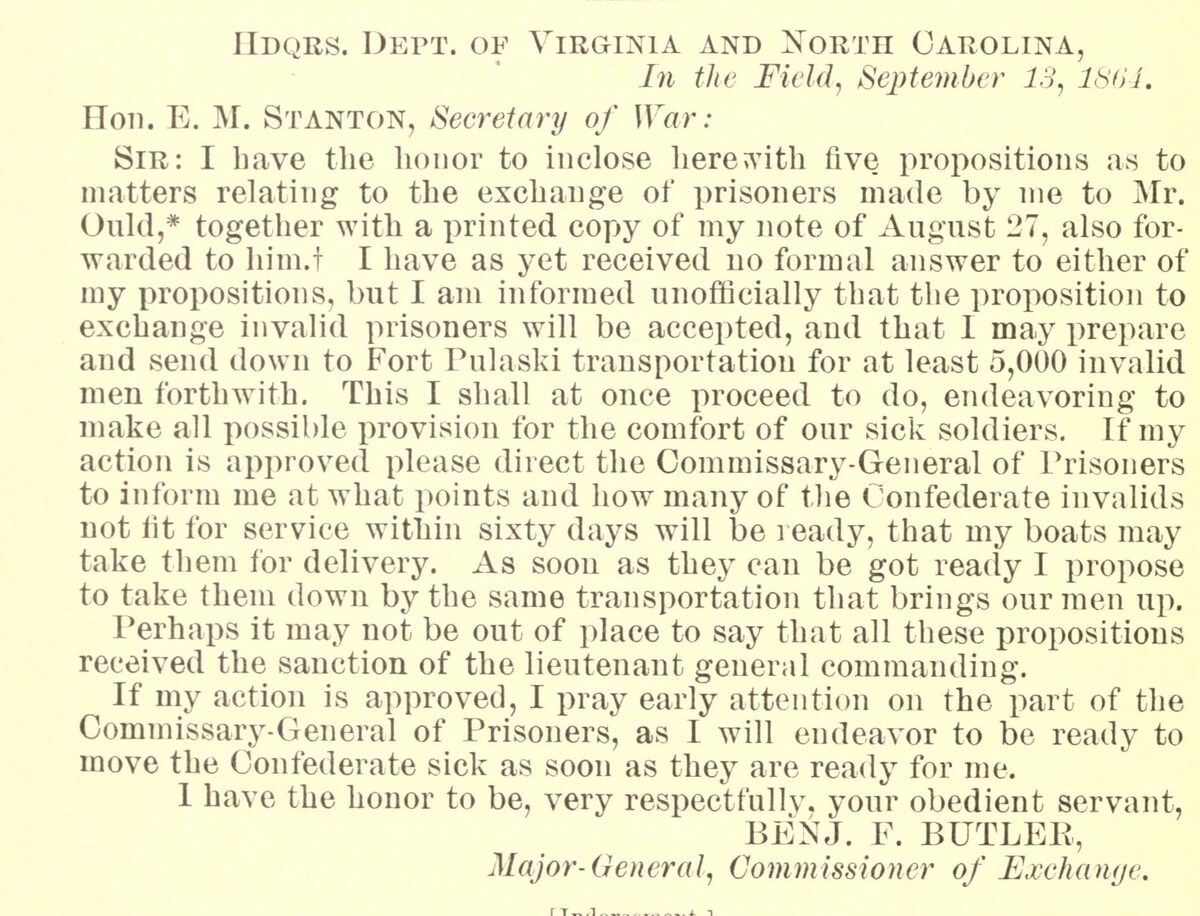
Six days before this telegram, Butler wrote to the Secretary of War that he expected to “prepare and send down to Fort Pulaski transportation for at least 5,000 invalid men forthwith.” That letter has been in print in the Official Records for well over a century (Series II, volume VII, p. 818)[6], and it is not alone. Follow-through on the same plan is printed a few pages later[7], and the exchange programme is documented across the Official Records, the Butler correspondence and Butler’s own memoir.
So the operation is not a discovery, and this solution does not pretend it is. Notice how little the published letter gives you of the telegram: a different date, a different writer, a different recipient, a different destination, a different deadline and a different number. It is the same programme six days earlier and in another stage. It is not this message.
No new key. Nineteen cells use public-table or previously checked traffic evidence. One position in that book had not been recorded in this project’s register before, and it is registered now. Nothing here is a recovered system.
Two cells are not key facts. Are for R. and Webster kept as a surname are arguments about this signature, fixed by the Rucker correspondence rather than by the table, and they are deliberately not promoted into reusable rows.
One transcription alternative would break the numbers. Cell 24 was read independently as waldo and, at about nine to one against, as walds. waldo is Thousand in the book, and the pixels and that key position both favor it. If the reading were ever adjudicated the other way, the five thousand seven hundred would not stand as written. That is a live falsifier for the figure, not a tidied-away doubt, and it is recorded rather than discarded.
The physical copy of the book is not identified. Six of these books survive at the Huntington, mssEC 41 through mssEC 46, and their numeral inserts agree on all twenty-nine values and on 55 of 58 alias spellings. The three that differ matter here. The traffic in this volume writes Harsh for Twenty and Leg for Forty, which is what five of the six copies print. mssEC 45, the copy cited throughout this page, prints Harshe and Leo[3]. Cell 19 of this telegram is harsh. So the identification is of the table family and not of the physical book on the operator’s desk, and on the two spellings that discriminate, mssEC 45 is the worst of the six witnesses rather than the best. A later Eckert volume records George D. Sheldon at Fort Monroe with a “No 1” and a “No 3” book, but it is catalogued 1865 to 1867 and names no copy, so it supports continuity of the system and not custody of any one volume in 1864.
The novelty claim is bounded, and it is a claim about a search, not about the world. What was tested is whether an exact clear copy, a word-for-word twin, a contemporary translation or an earlier reconstruction of this telegram could be found. The screen covered 132 Official Records volumes, ten selected OCR scans of telegraph histories and memoirs, including duplicate scans, all 156 public objects of the Decoding the Civil War project[8], all 1,710 catalogue objects of the sender’s own quartermaster file[5], 1,094 frames of the recipient’s, 938 objects of the Fort Monroe command press copies, and 52 indexed queries. It found none. It also passed its own sensitivity control, rediscovering the published Fort Pulaski programme it was not looking for, so the empty result is not simply a search that did not work.
Three named public interfaces, Google Books, HathiTrust and the Library of Congress, returned rate limits, challenges and timeouts rather than results. Those attempts are disclosed and not counted. The correct form of the claim is that no earlier reading was located in a bounded screen, never that none can exist. See the problem page for what would retire it.

